Learning how your body works at the end of pregnancy and during childbirth is very helpful as you prepare for birth. When you understand what is happening, you can interpret your body's signals more effectively and participate more fully in your labor and birth.
What do things look like inside?
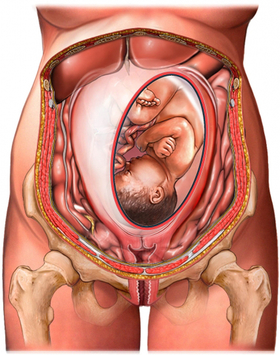
Let's review the basic anatomy of your pelvis, uterus, and cervix and the structures surrounding them and your baby.
- The bones and muscles of the pelvis provide support for the growing uterus and baby, and provide a passage through which your baby emerges during birth.
- The uterus surrounds the baby, growing as the baby grows.
- The cervix is actually a part of the uterus, but made up of different tissue. During pregnancy, the cervix is thick and closed. As you approach the time of birth, your contractions draw the cervix up into the body of the uterus, and it becomes thinner (called effacement) and opens (called dilation). When the cervix is fully dilated (about ten centimeters), contractions help the baby begin to move from the uterus into the vagina.
- The vagina leads from the cervix to the outside of your body. The inside of your vagina has many folds, called rugae, which unfold as the baby passes through.

What can I expect emotionally?
In addition to the natural physical preparation, you may also find yourself doing some emotional preparation. You may feel a strong need to be ready and want to tackle some last-minute projects. (Take it easy with these and pace yourself. Save your energy spurt for labor!)
You might find yourself worrying more than usual, and these worries might change. You might be concerned about making it through labor, whether your water will break in public, whether your own midwife or doctor will be on call when you go into labor, whether your partner will really be able to help you, or even whether you will have a bowel movement during the birth and how your partner might react to that. You might be worried about the safety of you and your baby during birth. You might be worried about having a cesarean section. You might even worry about dying. These concerns are common.
If you find that you are unable to relax because of worries, try to find a time each day to reflect on and acknowledge them. Call it your "worry time." You might try an exercise like this:
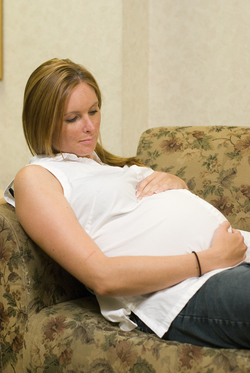 Choose a concern and state the concern out loud. For example, if you fear a cesarean section, you might say: "I am afraid that I won't be able to give birth vaginally."
- Mention some of your positive qualities or characteristics that might help with the concern. For example, "I am strong and healthy, and I am well-designed to give birth."
- Now restate the concern in a positive way, including the likelihood that it may or may not occur, and how your positive qualities will help you with your concern. "My strength will help me if I need to have surgery, but almost all women can give birth vaginally. I am strong, and I can too."
- Come up with a similar affirmation for each of your concerns. During your "worry time," repeat each affirmation several times and then tell yourself that worry time is over.
- For the remainder of the day, if you find worries creeping in, repeat the positive endings to the affirmations. ("I am strong, and I can give birth.") Give the majority of your energy to the positive statements.
Try the guided relaxation exercise, focusing on positive mental preparation for birth.
What are the stages of labor?
There are three stages of labor, excluding the preparatory changes discussed above.
- Dilation. You have contractions that work to open your cervix.
- Pushing. You have contractions that bring your baby down into the vagina and out into the world. You assist this process by pushing.
- Placenta. You continue to have contractions that free the attachment of the placenta, and you push the placenta out.
What influences the progression of labor?
Childbirth professionals often refer to the following factors influencing labor progression as the "Four Ps" of labor:
- Passenger (your baby)
- Passage (the pelvic bones, your cervix and vagina, and the muscles in your pelvis)
- Power (your contractions)
- Psyche (your emotions)
The dilation stage
What can I do during the dilation stage?
Try to rest and conserve your energy. Consider using progressive relaxation, imagery, positive affirmations, and emotional support to help relieve anxieties and encourage the progression of labor. More tips for relaxing and preparing are covered here.
When should I go to the hospital?
In general, most providers and most laboring women agree that early labor is best spent at home. If this is your first baby, you might consider waiting until the contractions are three minutes apart before calling your provider or hospital, but if you have had children in the past or live far from the hospital, then use the five-minute guideline.
The pushing stage
What happens in the pushing stage?
After your cervix has opened fully and the baby has descended low enough into the pelvis to push on the muscles and nerves of the pelvic floor, you may begin to feel an urge to push. During this stage, the contractions become expulsive.
What should I do in the pushing stage?
Once pushing begins, follow your body's urges. Try different positions to see which feels best to you.
Effective birthing positions
This article demonstrates positions that can be used for pushing as well as for giving birth.
Birthing Positions
The following pictures demonstrate positions that can be used for pushing as well as for giving birth. You may try several of these positions during the second stage of your labor. Consider trying them out at home, before labor starts, following these tips:
- Don't actually push or bear down as you "practice" a position, but simply get into each position and maintain it for the length of a contraction (about 60-70 seconds).
- Consider what support you need to get into the position, where pillows and hands of helpers can support you most effectively, and how you would assume a position of rest and relaxation after the contraction is over.
- Remember that the position of your body is important as you push. Notice in each position that the mother is curved forward, and that her head is down. Curling forward and tucking your chin helps the baby to navigate the curves of the pelvis. Arching your back and neck is much less helpful to this process. In many positions, notice that the mother has grasped her legs behind her knees and pulls her legs back. When doing this, it is most effective if your elbows are out, as if you were rowing a boat. If others help support your legs, they should merely support them, not force them back or apart. These position adjustments are things that your birth partner(s) can remind you of as you push.
Birthing bar
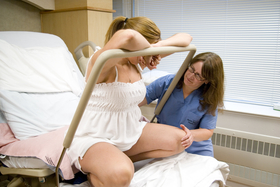 A birthing bar is an attachment that can be added to most labor beds to help facilitate a squatting position. The squatting position helps to expand the size of your pelvis, and uses gravity to promote the downward movement of your baby. When using the bar, the foot of the bed can be dropped, and the head of the bed raised high. Between contractions, you can sit, supported by the head of the bed, and then during contractions, move forward to squat, supported by the bar.
There is an alternative way to use the birthing bar. The vertical supports of the bar are used to rest your feet, and a sheet or towel is looped over the top of the bar. During the contractions, you grasp and pull back on the sheet as you push downward. This alternative might be helpful if you are too short to be comfortably supported by the bar in the squatting position or if you have had an epidural and your legs are too numb to safely support you in a squatting position.
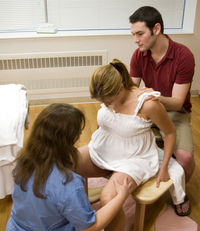 Birthing stool
A birthing stool can help you push in a very familiar position: the position you are used to using for having a bowel movement. Additionally, the low height of the stool flexes your legs and expands the size of your pelvis, and the upright position helps use gravity to promote the downward movement of the baby.
You would push in the position shown, and then between contractions can lean backward to rest supported by your partner.
Kneeling
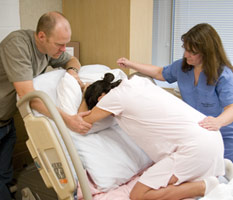 While pushing or giving birth on your knees may be used by any woman, it may be especially effective if you have had back pain during labor, as it helps to encourage movement of the baby. During the contraction, you flex your hips and lower your buttocks slightly as you push. Between contractions, you can drape yourself over the head of the bed to rest and relax.
You may try this position on your hands and knees, but, as your wrists may quickly become tired of supporting your body, you may find it easier to rest on your forearms as illustrated by this mother.
In an alternative to this position, you may drape your upper body over a birthing ball.
Semi-seated, with support
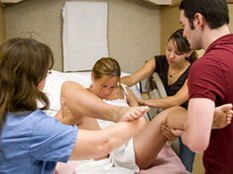 This position is not as effective in opening the pelvis as the upright positions illustrated above, but is probably the most common position used for the actual birth of baby - not necessarily because it is the best position for birth but, as you can imagine, it is the most convenient position for your doctor or midwife.
In this illustration, notice that the head of the bed is raised to at least 30 degrees or greater, and that the mother has a pillow placed under her right hip, helping her turn slightly to the left. These adjustments help keep the weight of her uterus and baby from interfering with blood flow through the vessels that flow behind them.
Notice also that she is curled forward around her baby, holding behind her knees, and that her support people are merely supporting her legs and her upper back, not pushing on them.
Sitting upright
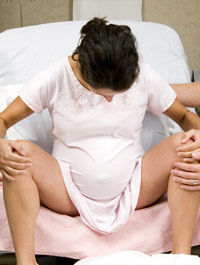 This upright sitting position is a variation on the use of a birthing stool.
Notice how the mother is curled forward around her baby, with her elbows out as she pushes. The head of the bed is raised high, and the foot of the bed is lowered, giving you a place to place your feet.
Like the use of the stool, this position helps you use gravity effectively. Between contractions, you can lean backward supported by the bed. If you like, your partner can also sit behind you in bed as you use this position.
Side, curled position
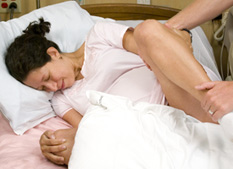
The side-lying position is especially useful in promoting rest and relaxation between pushing contractions.
Some research suggests that this is the most effective birthing position for preventing tears.
What do I need to know about the third stage (placenta)?
Your baby is out. You might be holding the baby, or you might have asked someone else to hold the baby briefly while you regroup. Many babies cry vigorously shortly after birth, some breathe readily but are quieter, and a few need a little encouragement in their transition and might be moved briefly to an infant warmer.
While you are getting to know your baby, your doctor or midwife is watching for signs that your placenta is ready to come out. They will remind you of your final physical task of labor, and ask you to push out your placenta. While you admire the baby, your uterus continues in its work, contracting and reducing in size, so that the placenta detaches from its site. Once this has happened, a few pushes are usually all that is required to birth the placenta.
Generally, the placenta is delivered within a few minutes, but delays of up to thirty minutes are considered normal. If the separation is delayed, breastfeeding the baby or stimulating your nipples may help trigger contractions to encourage separation. Some midwives and doctors give medication, such as oxytocin to help encourage separation, or they may give the medication after the placenta is out to help minimize bleeding.
Now what?
One of the limitations of this website is similar to that of many childbirth classes or preparation books. In the focus on childbearing, little attention is paid to the aspect that will ultimately take up much more of your time and lead to more personal growth than pregnancy and birth ever did: your new role as a parent.
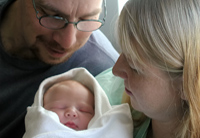 We hope that many of the things you have learned during your pregnancy and birth will also prepare you for your growth as a parent. A holistic approach to parenting and taking care of yourself while parenting offers countless benefits, including a thoughtful awareness of how you are feeling physically, emotionally, and spiritually.
Complementary therapies and practices you might have learned during pregnancy, such as massage, Reiki, and aromatherapy, can continue to offer healing comfort and relief from physical symptoms. Additionally, the methods of relaxation that you adopted during pregnancy can help relieve stress, both during your child's infancy and throughout the growth of your child. Indeed, many parents have stated that they draw on the strength they found in childbirth during challenging times of parenting.
Finally, skills you learned in advocating for yourself in the healthcare system remain important, both for yourself and for your child.
The author of one of the most famous books on childcare, Dr. Spock, starts each edition with the words, "Trust yourself." You can. No one else will ever know your child or have his or her best interests at heart as much as you do
Pregnancy Affirmation
Listen to this affirmation. It will help you trust in your body's abilities during pregnancy and childbirth.
Learn Relaxation Techniques
Here are some simple stress-reducing strategies to help you lessen the impact of stress on your health and wellbeing.
Practice mindful relaxation
Mindful relaxation is an effective way to combat stress. With a little practice, you can learn how to shift into a relaxation mode. When done successfully, the relaxation response increases alpha brain wave activity and lowers blood pressure, pulse, respiration rate, metabolic rate, oxygen consumption, anxiety, and produces a greater sense of wellbeing.
Over time, you will develop an ability to shift into a more relaxed state in the midst of stressful situations.
Try these steps to help you achieve mindful relaxation:
 Commit to an uninterrupted length of time each day to do your practice. You might begin with five minutes and increase from there. Twenty minutes of relaxation once or twice a day is optimal.
- Choose a quiet place. Turn off the television, radio, computer, and telephone.
- Find a comfortable body position. You can sit or recline in a chair, or settle comfortably on the floor. Make sure you feel supported.
- Focus on the repetition of a word, sound, prayer, or your breath flowing in and out.
- Create a positive state of mind. While you may not always be able to block out worries or negative thoughts, you don't need to attach to them. Let them float by like clouds in the sky.
Try breathing techniques
Another way to master stress is to be aware of your breathing. When people feel panicked or unconsciously stressed, they tend to take short, shallow gasps of air. The resulting lack of oxygen restricts blood flow and causes muscles to tense. By allowing more air to enter your body, you slow down your heart rate, lower your blood pressure, and break the stress cycle.

2-minute relaxation technique
- Focus your attention on your breathing. Take a few deep breaths, exhaling slowly.
- Mentally scan your body. Notice areas that feel tense or cramped. Quietly loosen them. Let go of as much tension as you can.
- Rotate your head in a smooth, circular motion once or twice, avoiding any movements that cause pain.
- Roll your shoulders forward and backward several times. Let all of your muscles completely relax.
- Recall a pleasant thought, event, or place.
- Take deep breaths and exhale slowly.
Use imagery
 Imagery exercises use creative imagination to "picture" scenarios that relax and heal. They can be done on your own, or with a facilitator guiding you, which is called guided imagery.
A common relaxation practice is to mentally picture yourself in a pleasant place that puts your mind and body at ease. For example, imagine yourself lying on a beach with the sun shining, listening to the waves. It is important to imagine a place that has a positive association for you (an ocean beach may not be a pleasant place for everyone).
Another use of imagery is when cancer patients imagine their healthy cells eating and destroying cancerous cells. Studies done with cancer patients show that the use of guided imagery markedly improves stress levels.
Add body exercises
Having awareness of where you store stress in your body is another important part of stress reduction. Learn how to release tension in your body by trying the following exercises.
- Body scan
- Progressive muscle relaxation
- Shoulders and neck relaxation
Learn more about yogaIn addition, mindful movement practices such as yoga, tai chi, and qi gong, are excellent for reducing body tension and stress and increasing flexibility and equanimity. These exercises are becoming increasingly popular and common, and they are available at many local community centers, schools, and health clubs.
Consider biofeedback
Biofeedback uses a measuring device to assess how relaxed you are and teach you how to relax more effectively. Biofeedback equipment monitors systems of which you are not normally aware, such as blood pressure, pulse, temperature, and brain wave patterns. As you practice biofeedback, you develop the ability to change these systems (for example, lower your blood pressure).
You can try a simple biofeedback exercise on your own, using a thermometer as a guide. Hold a thermometer between your index finger and thumb, and note the temperature. Then complete one of the relaxation techniques previously described. After your session, measure your temperature again.
If you are interested in further exploring biofeedback, consult with a psychologist or other health provider who works with it.
More ways to relax

Meditation exercise
Meditation can induce relaxation, and it has numerous other benefits. Listen to this mindful breathing meditation.

Take 5: Guided imagery video
In our daily lives, we often rush from meeting to meeting, appointment to appointment, class to class, with little opportunity to catch our breath! We encourage you to Take 5 for a calmer mind.

10-minute seated body scan
Learn to bring more awareness and relaxation to your body with this short video
Comments
Post a Comment
Thanks